Saturday, October 31, 2009
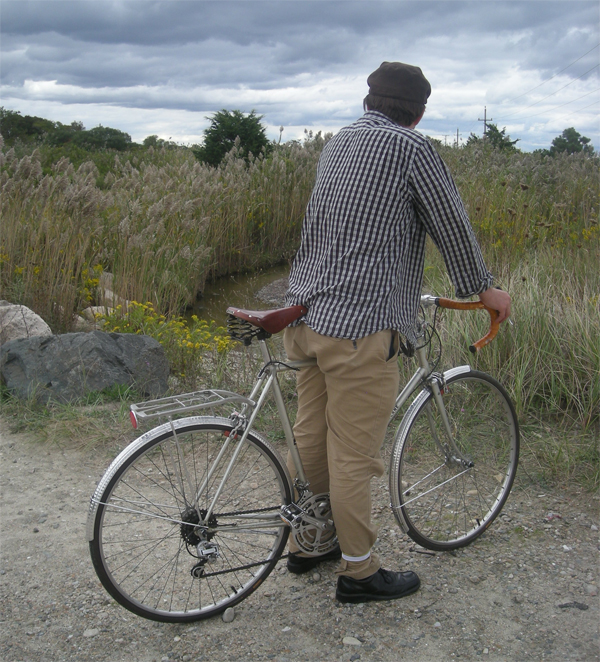
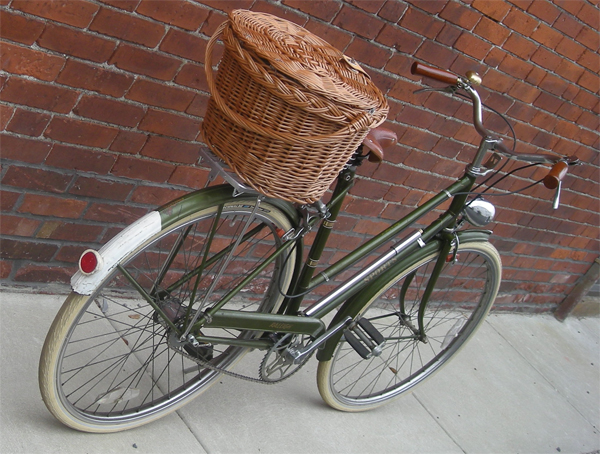
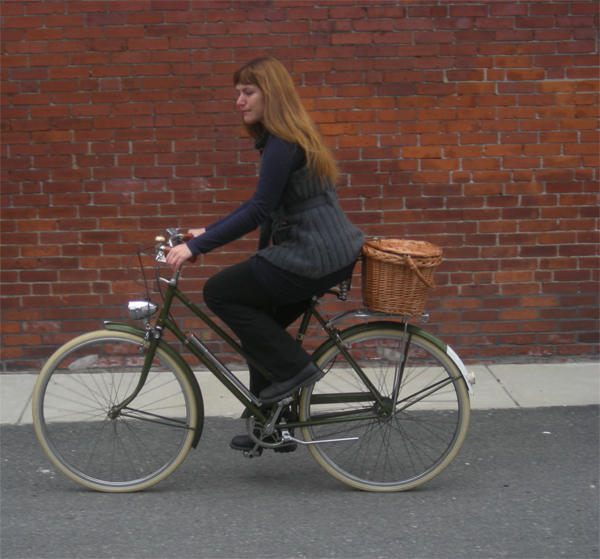
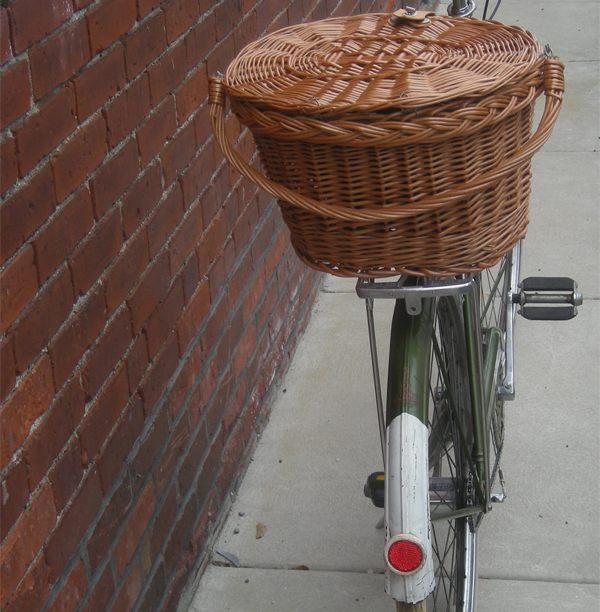
Friendly Witches and Scenic Graveyards
Posted on 6:46 PM by dvdsvdsdv
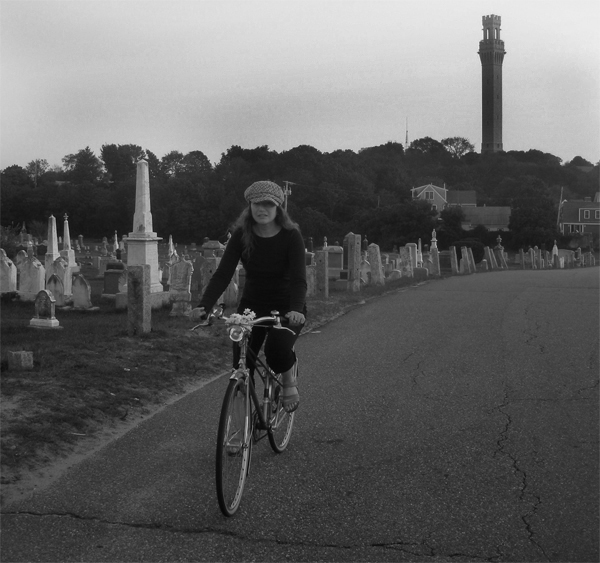
Posted in basket, Cape Cod, Eustacia Vye, holidays, lights, loop frame, Marianne, Motobecane, night time cycling, Pashley
|
No comments
Friday, October 30, 2009
Made in Somerville: The Joys of a Locally Built Bicycle
Posted on 6:34 AM by dvdsvdsdv
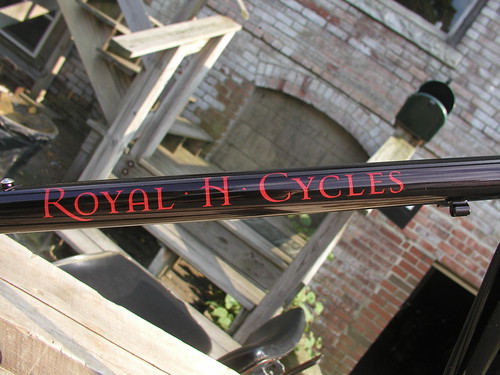
I tried to hint at this subtly in previous posts, but judging by some recent conversations I was a too subtle. So it is time to announce this formally: I am getting a custom bicycle from Royal H. Cycles.
No, please relax - it is not the track bike mentioned earlier! My Royal H. will be a classic Randonneur-style mixte, inspired by the early French constructeurs: fully lugged, with twin lateral stays and a touring geometry. Even as I write it, I do not really believe it. Yes, it will be utterly glorious, and no, I cannot afford it. But I've been finding some creative ways to scrimp, save, and earn extra cash, and it's all coming together nicely (the deposit system really helps as well!). The frame will be ready in November, and then I will spend the winter fitting it with components. In the springtime, the complete bicycle shall emerge just as the crocuses come into bloom and the swallows sing their song.
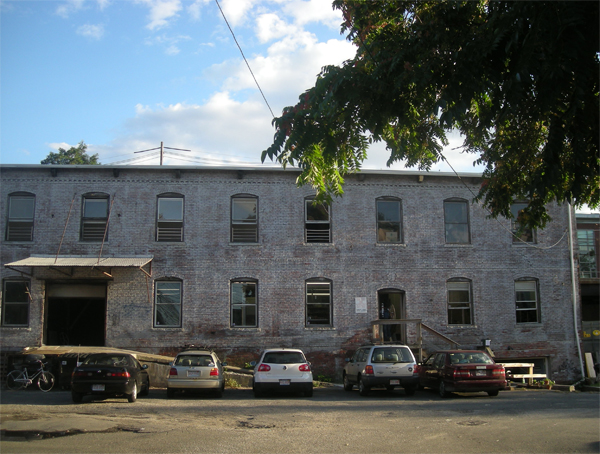
However, what I really want to talk about is not the bicycle itself, but the experience of having it custom made by a local framebuilder. As far as "local" goes, you can't really get more local than this: The Royal H. studio (pictured above) is a 5-minute bike ride from my house, so my bicycle is being built in my own neighborhood. There is nothing quite like this.
I met the framebuilder Bryan Hollingsworth through Open Bicycle, after I saw a purple Royal H. bike belonging to one of their customers and was taken with its elegant styling. "Who made that?" I asked. And the rest was history. I met Bryan in person, discussed my ideas with him, and it was immediately clear that he understood exactly what I was talking about and would enjoy making it. It was an exciting, high-energy first meeting and in the end I had no doubt that this person was the right framebuilder for me. This might seem trite, but it can be very helpful for the framebuilder to get a good sense of the customer's individual style by interacting with them. And getting a sense of your individual style will enable them to use their creativity to make a truly personalised bicycle.
The proximity of Royal H. has also allowed me the unique opportunity to visit my frame at various stages of completion, watch it develop, and give Bryan feedback to any questions or new ideas that came up. I have held the different parts of my frame in my hands before it was a frame - the lugs, the tubes, the dropouts, the little braze-ons! - and I watched Bryan arrange them on his drawing-board. This was a thrilling experience, and it has deepened my sense of connectedness to this bicycle. It is definitely my frame, I was there as it evolved! Thanks to Bryan's generous narration about his process, I have also learned a bit about how bicycles are built in the meantime.
To add a few words about Bryan Hollingsworth himself: For the past three years, he has been a framebuilder for Seven Cycles, where, interestingly enough, he specialises in carbon fiber frames. Recently Bryan has branched out into a private frame building practice and started Royal H., with a focus on classic lugged steel bicycles. The art nouveau aesthetic of his work appeals to me very much, and I often find myself admiring his frames even when the bicycle is completely inappropriate for me - like the cream track bike I mentioned earlier.
And notice how simple everything here is: No over-the-top lugwork, no eccentric curvature, just a classic, minimalist track frame. But to me, it stands out from other track frames.
Of course my mixte will look very different from the cream track bike, but it will have a similar art nouveau aesthetic and, hopefully, the same feel of understated elegance.
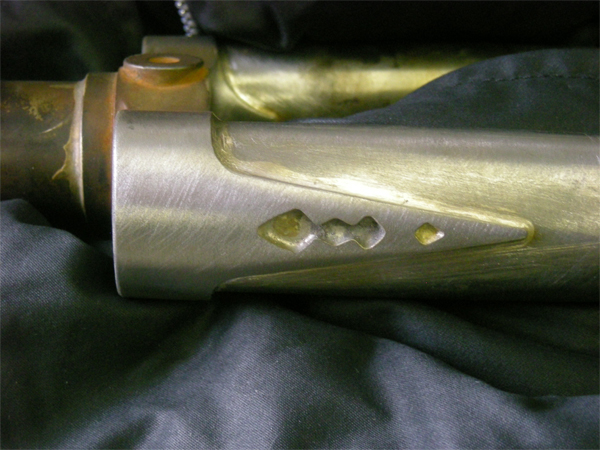
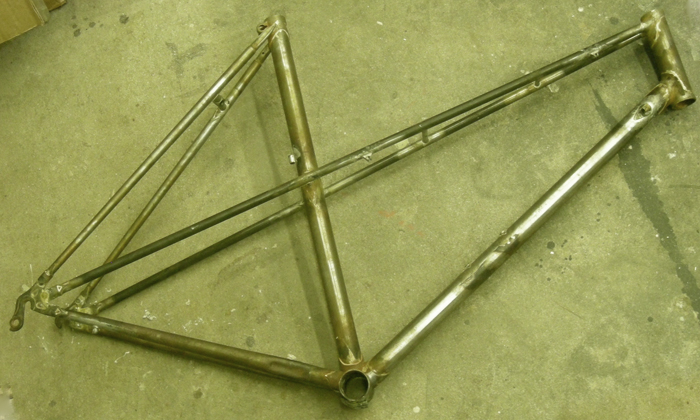
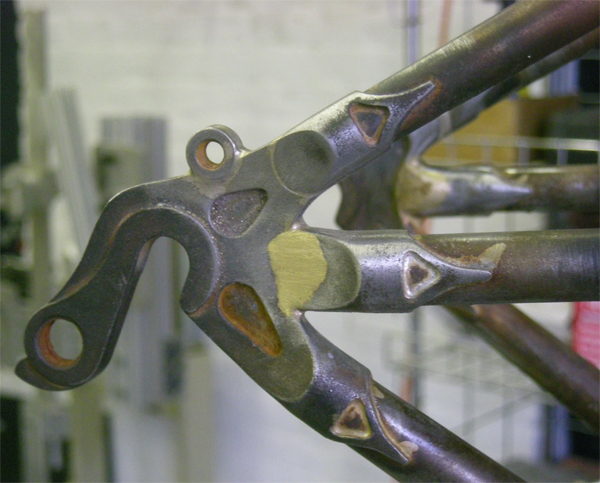
My frame is a fairly complicated one, and there are many special things about it that you will not see on any other bicycle (like these custom dropouts!). Bryan has impressed me on more than one occasion with his ability to combine innovative solutions with classic looks, and I will no doubt dedicate several future posts to boring you with the technical details and pornographic close-ups of my bicycle. But not to worry, that won't be for another couple of months.
In the meanwhile, I encourage you to get to know your local framebuilders, or to find independent framebuilders in an area of the country that has personal meaning for you. Boston, Massachusetts holds a special place in the history of bicycle manufacturing since the late 1800's, and Somerville in particular was home to several legendary builders, including Fat City Cycles and Merlin Metal Works in the 1980s and '90s. In fact, the Union Square neighborhood where Open Bicycle and Royal H. are located was the former home of these manufacturers. Today, the Boston area boasts famed artisanal framebuilders such as Peter Mooney and Mike Flanigan, the internationally renown Seven Cycles and Independent Fabrications, the innovative Geekhouse, and attention-worthy young builders including Icarus and Royal H. When the context and history of your bicycle's production are meaningful to you, owning it will feel truly special. I plan to have future posts dedicated to local framebuilders, to the framebuilding process, and to the history of bicycle manufacturing in Boston, and I hope that these will be of interest.
No, please relax - it is not the track bike mentioned earlier! My Royal H. will be a classic Randonneur-style mixte, inspired by the early French constructeurs: fully lugged, with twin lateral stays and a touring geometry. Even as I write it, I do not really believe it. Yes, it will be utterly glorious, and no, I cannot afford it. But I've been finding some creative ways to scrimp, save, and earn extra cash, and it's all coming together nicely (the deposit system really helps as well!). The frame will be ready in November, and then I will spend the winter fitting it with components. In the springtime, the complete bicycle shall emerge just as the crocuses come into bloom and the swallows sing their song.
However, what I really want to talk about is not the bicycle itself, but the experience of having it custom made by a local framebuilder. As far as "local" goes, you can't really get more local than this: The Royal H. studio (pictured above) is a 5-minute bike ride from my house, so my bicycle is being built in my own neighborhood. There is nothing quite like this.
I met the framebuilder Bryan Hollingsworth through Open Bicycle, after I saw a purple Royal H. bike belonging to one of their customers and was taken with its elegant styling. "Who made that?" I asked. And the rest was history. I met Bryan in person, discussed my ideas with him, and it was immediately clear that he understood exactly what I was talking about and would enjoy making it. It was an exciting, high-energy first meeting and in the end I had no doubt that this person was the right framebuilder for me. This might seem trite, but it can be very helpful for the framebuilder to get a good sense of the customer's individual style by interacting with them. And getting a sense of your individual style will enable them to use their creativity to make a truly personalised bicycle.
The proximity of Royal H. has also allowed me the unique opportunity to visit my frame at various stages of completion, watch it develop, and give Bryan feedback to any questions or new ideas that came up. I have held the different parts of my frame in my hands before it was a frame - the lugs, the tubes, the dropouts, the little braze-ons! - and I watched Bryan arrange them on his drawing-board. This was a thrilling experience, and it has deepened my sense of connectedness to this bicycle. It is definitely my frame, I was there as it evolved! Thanks to Bryan's generous narration about his process, I have also learned a bit about how bicycles are built in the meantime.
To add a few words about Bryan Hollingsworth himself: For the past three years, he has been a framebuilder for Seven Cycles, where, interestingly enough, he specialises in carbon fiber frames. Recently Bryan has branched out into a private frame building practice and started Royal H., with a focus on classic lugged steel bicycles. The art nouveau aesthetic of his work appeals to me very much, and I often find myself admiring his frames even when the bicycle is completely inappropriate for me - like the cream track bike I mentioned earlier.
And notice how simple everything here is: No over-the-top lugwork, no eccentric curvature, just a classic, minimalist track frame. But to me, it stands out from other track frames.
Of course my mixte will look very different from the cream track bike, but it will have a similar art nouveau aesthetic and, hopefully, the same feel of understated elegance.
My frame is a fairly complicated one, and there are many special things about it that you will not see on any other bicycle (like these custom dropouts!). Bryan has impressed me on more than one occasion with his ability to combine innovative solutions with classic looks, and I will no doubt dedicate several future posts to boring you with the technical details and pornographic close-ups of my bicycle. But not to worry, that won't be for another couple of months.
In the meanwhile, I encourage you to get to know your local framebuilders, or to find independent framebuilders in an area of the country that has personal meaning for you. Boston, Massachusetts holds a special place in the history of bicycle manufacturing since the late 1800's, and Somerville in particular was home to several legendary builders, including Fat City Cycles and Merlin Metal Works in the 1980s and '90s. In fact, the Union Square neighborhood where Open Bicycle and Royal H. are located was the former home of these manufacturers. Today, the Boston area boasts famed artisanal framebuilders such as Peter Mooney and Mike Flanigan, the internationally renown Seven Cycles and Independent Fabrications, the innovative Geekhouse, and attention-worthy young builders including Icarus and Royal H. When the context and history of your bicycle's production are meaningful to you, owning it will feel truly special. I plan to have future posts dedicated to local framebuilders, to the framebuilding process, and to the history of bicycle manufacturing in Boston, and I hope that these will be of interest.
Posted in Boston, framebuilding, local bike shops, lugs, mixte, Royal H, Royal H. Mixte, shop visits
|
No comments
Thursday, October 29, 2009
All-Weather Friend
Posted on 3:24 AM by dvdsvdsdv
Yesterday was a horrible, rainy day, and during the worst part of it I had to go out. Looking out the window, it was rapidly growing dark and water was literally pouring in streams from the sky. On a day like that, the question of which bike to take did not even enter my mind: I put on my waterproof trench and grabbed Eustacia Vye.
It was raining so hard, that I felt as if I was swimming rather than cycling: I had to keep wiping water off of my face. Between the darkness and the rain, it all looked like an impressionist painting.
Nonetheless, the ride itself was quite comfortable. Eustacia remained stable and easy to maneuver even through lake-sized puddles. The brakes worked perfectly. The lights shone brightly. I felt safe in traffic despite the wet conditions and the limited visibility. Once I got used to the feeling of water running down my face, it was even fun.
There were almost no other cyclists out, and one of the few I did see had an accident right in front of me: While turning a corner, she rode over some leaves and her bicycle flipped sideways. I knew that this could happen, but have never experienced it or seen it. She was cycling slowly, and it still happened. The cyclist was not hurt (I stopped to make sure she was all right), but still - falling like that could not have been pleasant. It seems that wet leaves really are extremely slippery and it is important to avoid them, especially when cornering.
The fallen cyclist was riding a diamond-frame bike, with tires that looked narrow and worn out. She expressed admiration for my Pashley and said that on a bike like that she bets this would not have happened to her. I am not so sure, as I have heard of people slipping on wet leaves and metal grates even on mountain bike tires. Still, I was acutely aware of how much of a luxury my tank of a bike was on a horrible day like this. I was comfortable, whereas the few other cyclists out there looked like they were miserable - struggling against the elements as well as their bikes' limitations.
Here we are together in the rainy darkness. Not very flattering to either of us, but it captures the mood. My true all-weather friend. I must not forget this the next time I compare her to faster and more nimble bikes.
The fallen cyclist was riding a diamond-frame bike, with tires that looked narrow and worn out. She expressed admiration for my Pashley and said that on a bike like that she bets this would not have happened to her. I am not so sure, as I have heard of people slipping on wet leaves and metal grates even on mountain bike tires. Still, I was acutely aware of how much of a luxury my tank of a bike was on a horrible day like this. I was comfortable, whereas the few other cyclists out there looked like they were miserable - struggling against the elements as well as their bikes' limitations.
Wednesday, October 28, 2009
I Don't Want You, But I Need You... When Bike Love Turns Irrational
Posted on 1:43 PM by dvdsvdsdv
Once in a while, I see a bicycle that is completely unnecessary for my lifestyle, and perhaps even impossible to ride given my skill level... And yet, that bicycle fills me with desire. Here are three bad-boys that evoke these conflicted feelings. (For maximum enjoyment, I suggest playing "You Really Got a Hold on Me" as background music.)
[Rivendell Bombadil, fitted with cream Fat Frank tires. Image from Bearded Peter]
The Bombadil is a clear-coated, lugged steel mountain bike from Rivendell. It is completely rigid (no front or rear suspension), and comes with a double-top-tube frame. I see myself as a Warrior Princess seated high over the fearsome double top-tubes and hopping over roots and rocks with wild abandon - my hair fluttering in the wind like a fiery trail and my face streaked with dirt (attractively accentuating my cheekbones)... Of course, I really should learn to at least mount and dismount a bike properly before entertaining such fantasies...
[A.N.T. Basket Bike, lady's frame, in blue-gray. Image from antbike]
Here is my most recent forbidden love: the A.N.T. Basket Bike, lady's frame. I do not require a specialised basket bike. But every time I look at this photo, I want to cry. It is so beautiful, and I have never seen anything quite like it. (Yes, I know that the idea of a transport bike with a small front wheel is not new, but they did not usually come with such graceful frames.) I absolutely love the classic Porteur chaincase, and that slate gray is one of my favourite colours. The overall look is at once so vintage and so modern and so... poetically eccentric, that my very soul cries out for it. Yes, my soul. These are some heavy feelings I am sharing with you.
[Royal H. Cycles, track bike. Image from Royal H.]
And finally, the most bizarre crush I've had: This is a track bike by Royal H. Cycles. The enormous frame is painted cream, and the lugs are meticulously outlined in a rich orange. I can't explain why I have such a strong reaction to it. I can't ride fixed gear to save my life, and I don't like orange. But I look at it, and it just seems so... perfect. If I gaze at it for too long, I feel the need to learn how to ride fixed immediately. And also to stroke it and feed it caramels while whispering sweet nothings in its ear... Is that wrong?
The Bombadil is a clear-coated, lugged steel mountain bike from Rivendell. It is completely rigid (no front or rear suspension), and comes with a double-top-tube frame. I see myself as a Warrior Princess seated high over the fearsome double top-tubes and hopping over roots and rocks with wild abandon - my hair fluttering in the wind like a fiery trail and my face streaked with dirt (attractively accentuating my cheekbones)... Of course, I really should learn to at least mount and dismount a bike properly before entertaining such fantasies...
Here is my most recent forbidden love: the A.N.T. Basket Bike, lady's frame. I do not require a specialised basket bike. But every time I look at this photo, I want to cry. It is so beautiful, and I have never seen anything quite like it. (Yes, I know that the idea of a transport bike with a small front wheel is not new, but they did not usually come with such graceful frames.) I absolutely love the classic Porteur chaincase, and that slate gray is one of my favourite colours. The overall look is at once so vintage and so modern and so... poetically eccentric, that my very soul cries out for it. Yes, my soul. These are some heavy feelings I am sharing with you.
And finally, the most bizarre crush I've had: This is a track bike by Royal H. Cycles. The enormous frame is painted cream, and the lugs are meticulously outlined in a rich orange. I can't explain why I have such a strong reaction to it. I can't ride fixed gear to save my life, and I don't like orange. But I look at it, and it just seems so... perfect. If I gaze at it for too long, I feel the need to learn how to ride fixed immediately. And also to stroke it and feed it caramels while whispering sweet nothings in its ear... Is that wrong?
Tuesday, October 27, 2009
Old English vs New English
Posted on 11:59 AM by dvdsvdsdv
Monday, October 26, 2009
Time Traveling
Posted on 9:44 AM by dvdsvdsdv
Saturday, October 24, 2009
Brooks Saddles: Demystifying the System
Posted on 2:23 PM by dvdsvdsdv
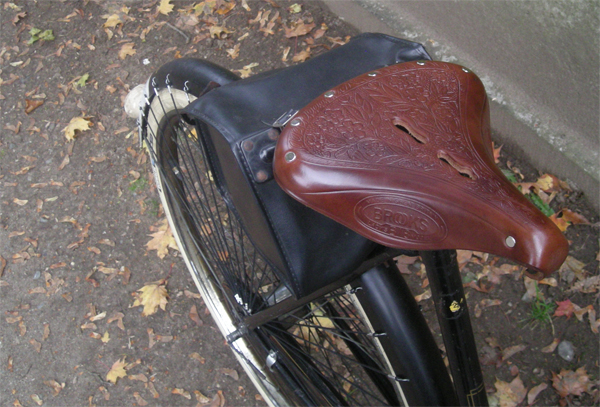
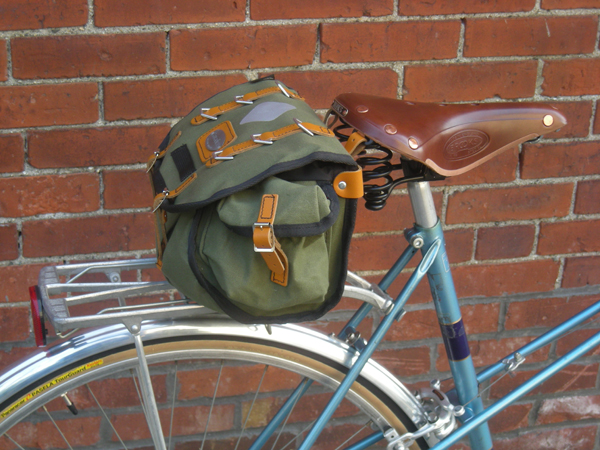
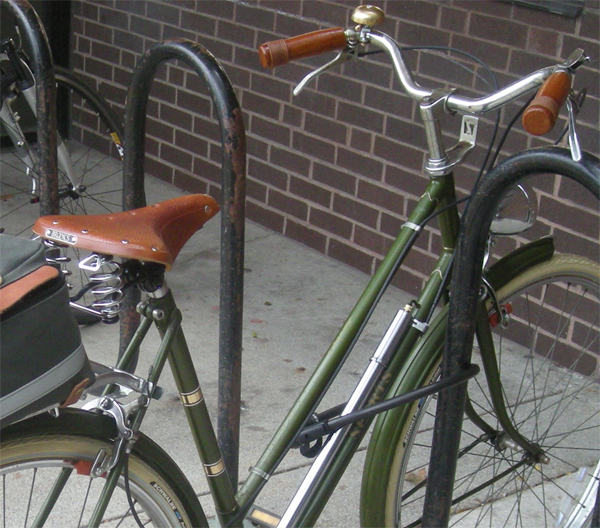
Lately there has been some discussion about Brooks saddles in the comments sections of the posts. We have Brooks saddles on all six of our bicycles, and we have learned a lot about them. So I offer these notes for those riddled with indecision about which Brooks to get.
When choosing a Brooks saddle, there are really only two main factors to consider: width and spring. I will try to explain the role of each.
WIDTH
The basic rule is: The more upright your riding position (handlebars above saddle level), the wider your saddle needs to be. Brooks saddles come in several width categories.
For upright riding: The B72, B66, B67, B68, and B73 are all pretty much the same, generous width and are all appropriate for a an upright bicycle. Which one of them you will prefer depends on your preference for sprung vs unsprung saddles, and whether your bicycle has a modern or an old-style seat post (for example, the B66 and B67 are identical, except the latter is designed to fit modern seat posts).
If you are heavier than 200lb and are riding a completely upright bicycle, you may want to consider the B33 or the B190. These are extra heavy-duty saddles and can take even the weightiest of riders on long upright trips.
If you are female, love Edwardian design, and have a bicycle with very relaxed geometry, there is also the B18 "Lady". This is a very wide and short saddle, designed to be ridden by women wearing skirts and sitting completely upright on a bicycle with an extremely slack seat tube. See here for a detailed discussion of this saddle.
For leaned-forward riding: If you are riding in a forward-leaning position so that your saddle is right at or above the level or your handlebars, in my opinion there are only two Brooks saddles to choose from unless you are a very aggressive cyclist: the B17 and the Flyer. These are in fact the same saddle, only the Flyer has springs and the B17 does not.
In my view, all the other Brooks roadbike saddles (the B17 Narrow, the Team Pro, the Swift, and the Swallow) are too narrow for the majority cyclists who are likely to be reading this post. Many do not want to hear that, because those racing saddles often have the coolest aesthetics and come in all sorts of crazy colours and special editions. But cycling forums are full of people who bought the narrow saddle and are not able to ride them - either due to discomfort, or because the saddle falls apart under the rider's weight. The cycling style of a serious road cyclist is so aggressive, that their butt really only floats on the surface of the saddle, rather than actually sits upon it. That is what these saddles were designed for. If this does not describe your cycling style, I urge you to get a B17 or a Flyer.
SPRINGS
Sprung saddles provide suspension, the benefit of which is that you feel more comfortable going over bumps on the road. The drawback of suspension, is that you have less "control" over the ride. Which you prefer can be only decided via trial and error. For an upright bicycle, I would venture say that most cyclists tend to prefer the sprung saddles. For a more aggressive bike, it could go either way.
It is worth pointing out that not all sprung Brooks saddles are sprung equally. The B72 has minimal springs. The Flyer has larger coils, but they are very tight and provide a feeling of shock absorbtion rather than full spring. So if you are considering putting a Flyer on a roadbike but are worried that it may be too bouncy, it may not necessarily be the case. The B66-67 is generously sprung. The B33 and B190 are monstrously sprung, so choose these carefully.
"MEN'S" vs. "WOMEN'S" SADDLES?...
You may notice that many saddles are offered in a "woman's" version, where the saddle number is followed by the letter "S" (B66 vs B66S). I think this system is often misunderstood. The "S" stands for "short", and these saddles are simply shorter than their non-"S" counterparts - making them somewhat easier to mount and dismount while wearing a skirt without the skirt getting caught on the nose. I have ridden on both "S" and non-"S" saddles, and am still not sure whether the skirt-snagging difference is significant.
SPECIAL FINISHES
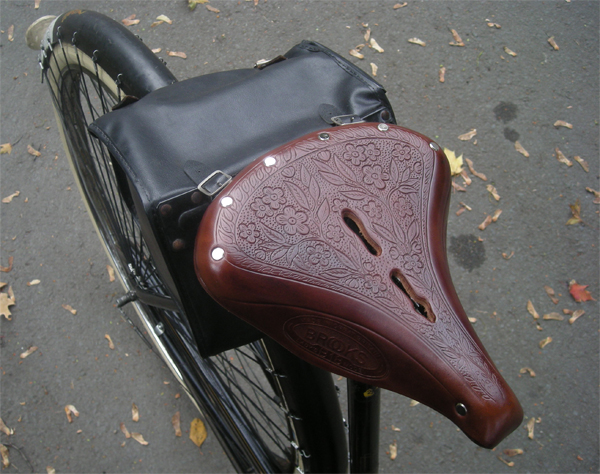
As for things like "Special," "Aged" and "Imperial" versions of the saddles, there is some debate whether they improve the saddle or not. The "Special" finish is more attractive and hardy than the regular finish, and features copper rivets. However, I and others have found saddles with the "Special" finish to be harder to break in. The "Aged" saddles are supposedly treated with some polymer, which some cyclists say improves their softness, while others say worsens it. And be careful choosing the "Imperial" versions of saddles, with cut-outs, because while some find those cut-outs helpful, others find them extremely painful. In short, my impression is that when in doubt it isa safer to go with standard finishes - unless you have a chance to try the saddle extensively.
To summarise it all:
If you need an upright saddle, choose one of these. If you will be cycling in a forward-leaning position, choose one of these. And unless you are an aggressive road cyclist, stay away from these. Sprung vs unsprung, and "S" vs non-"S", are personal choices within each category. Of course in the end everybody is different, but I believe this summary is applicable in the majority of cases.
WIDTH
The basic rule is: The more upright your riding position (handlebars above saddle level), the wider your saddle needs to be. Brooks saddles come in several width categories.
For upright riding: The B72, B66, B67, B68, and B73 are all pretty much the same, generous width and are all appropriate for a an upright bicycle. Which one of them you will prefer depends on your preference for sprung vs unsprung saddles, and whether your bicycle has a modern or an old-style seat post (for example, the B66 and B67 are identical, except the latter is designed to fit modern seat posts).
In my view, all the other Brooks roadbike saddles (the B17 Narrow, the Team Pro, the Swift, and the Swallow) are too narrow for the majority cyclists who are likely to be reading this post. Many do not want to hear that, because those racing saddles often have the coolest aesthetics and come in all sorts of crazy colours and special editions. But cycling forums are full of people who bought the narrow saddle and are not able to ride them - either due to discomfort, or because the saddle falls apart under the rider's weight. The cycling style of a serious road cyclist is so aggressive, that their butt really only floats on the surface of the saddle, rather than actually sits upon it. That is what these saddles were designed for. If this does not describe your cycling style, I urge you to get a B17 or a Flyer.
Sprung saddles provide suspension, the benefit of which is that you feel more comfortable going over bumps on the road. The drawback of suspension, is that you have less "control" over the ride. Which you prefer can be only decided via trial and error. For an upright bicycle, I would venture say that most cyclists tend to prefer the sprung saddles. For a more aggressive bike, it could go either way.
It is worth pointing out that not all sprung Brooks saddles are sprung equally. The B72 has minimal springs. The Flyer has larger coils, but they are very tight and provide a feeling of shock absorbtion rather than full spring. So if you are considering putting a Flyer on a roadbike but are worried that it may be too bouncy, it may not necessarily be the case. The B66-67 is generously sprung. The B33 and B190 are monstrously sprung, so choose these carefully.
You may notice that many saddles are offered in a "woman's" version, where the saddle number is followed by the letter "S" (B66 vs B66S). I think this system is often misunderstood. The "S" stands for "short", and these saddles are simply shorter than their non-"S" counterparts - making them somewhat easier to mount and dismount while wearing a skirt without the skirt getting caught on the nose. I have ridden on both "S" and non-"S" saddles, and am still not sure whether the skirt-snagging difference is significant.
SPECIAL FINISHES
As for things like "Special," "Aged" and "Imperial" versions of the saddles, there is some debate whether they improve the saddle or not. The "Special" finish is more attractive and hardy than the regular finish, and features copper rivets. However, I and others have found saddles with the "Special" finish to be harder to break in. The "Aged" saddles are supposedly treated with some polymer, which some cyclists say improves their softness, while others say worsens it. And be careful choosing the "Imperial" versions of saddles, with cut-outs, because while some find those cut-outs helpful, others find them extremely painful. In short, my impression is that when in doubt it isa safer to go with standard finishes - unless you have a chance to try the saddle extensively.
If you need an upright saddle, choose one of these. If you will be cycling in a forward-leaning position, choose one of these. And unless you are an aggressive road cyclist, stay away from these. Sprung vs unsprung, and "S" vs non-"S", are personal choices within each category. Of course in the end everybody is different, but I believe this summary is applicable in the majority of cases.
Friday, October 23, 2009
Godspeed, Lucy 3-Speed!
Posted on 3:12 PM by dvdsvdsdv
I am happy that I've been able to let go of these things, because I really never wanted to become a hoarder/collector. I love bicycles and bicycle accessories, but I am looking for a few that are perfect for me, rather than for a "stable". Maybe some day, when I have a house with a barn and more money. But for now, Godspeed!
Thursday, October 22, 2009
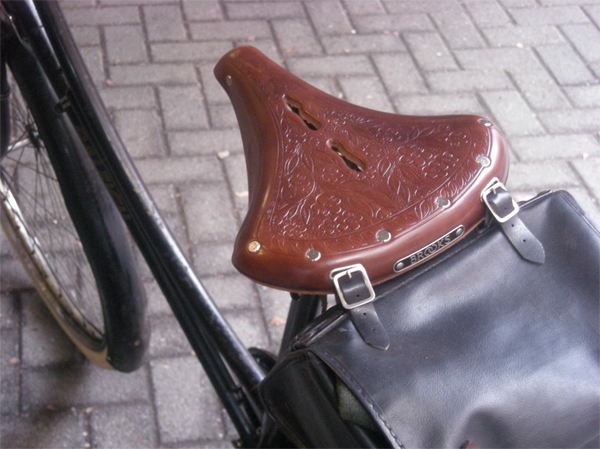
The "Lady" Finds a Home! (Thoughts on the Brooks B18)
Posted on 6:31 PM by dvdsvdsdv
Posted in Brooks, comfort, fenders, loop frame, Raleigh, restoration, rod brakes, saddles, skirt, Velouria, vintage
|
No comments
Wednesday, October 21, 2009
Ladies' Bicycles from ANT: 2 Test Rides
Posted on 5:05 PM by dvdsvdsdv
At their Open House last weekend, I had a chance to briefly examine and test-ride two ANT bicycles. This is my first time seeing these bicycles up close and personal, and I hope the reports will be useful to those considering an ANT.
TEST RIDE No.1: The Boston Lady Roadster
The Boston Lady Roadster is a classic loop frame bicycle, available custom built from ANT. This fact in itself is remarkable. If you are wondering why, I invite you to find other framebuilders willing and able to build a loop frame, or even capable of discussing such a thing without laughing. Until recently, most framebuilders' idea of a "women's bicycle" was a diamond frame roadbike painted pink, or with pink handlebar wraps. Now mixtes have began to pop up as well, but for city riding they are not quite as comfortable as the classic curved step-through. The fact that ANT has chosen the loop frame as one of their flagship models carries significant implications for the recognition of women in urban cycling. It also says something about the framebuilder's skill. It is difficult to make that curved top tube, to get the form just right both structurally and aesthetically. So I feel that this frame is one of the most specialised and special things ANT has to offer.
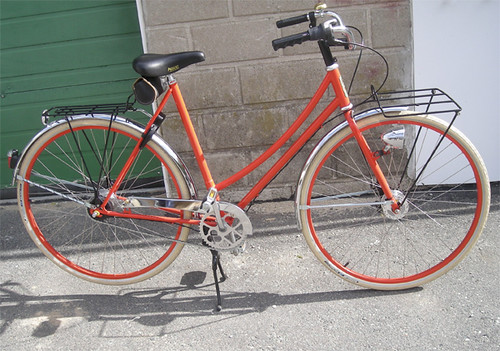
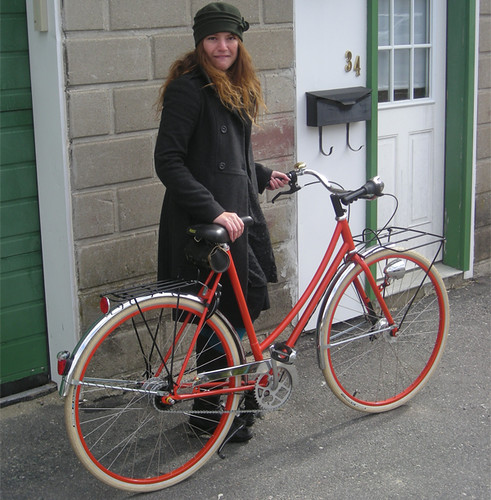
The Lady Roadster is available in many colours, with the option of matching rims and a choice of black or cream tires. The bicycle I tried was in a colour I would describe as "Vermilion" or "Cadmium Red Light" in painters' pigment terms. I must say, ANT knows how to put together colours. The combination of the vermilion frame, matching rims, cream tires and steel fenders is timelessly classic and elegant. At the Open House, someone asked me what I think of putting matching fenders on this bike, and my thought on that was "no". With a bright colour like this, I think it is easy to overdo it and make the bicycle look like a toy. To my eye, the clean steel fenders are a good counterweight to the extravagant frame and rim colour; it's all done just right. If it were my bicycle, I would ask for brown leather accessories and a steel quill stem for a more classic look, but that this is a matter of personal choice.
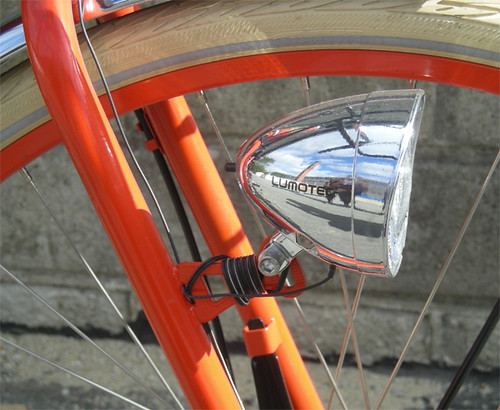
One of my favourite features of the Boston Roadster is the mount for the dynamo-powered headlight. Welded to the fork, it looks like a little tree branch. Having a low-mounted light like this is better for illuminating the road than having the light on top of the fork or on the handlebars, so this feature serves a practical purpose as well.
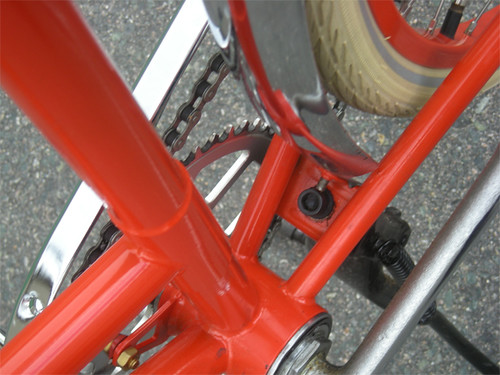
This shot may not speak to you immediately, but I wanted to point out the kickstand plate. Not all bicycles are made with one. Also note how neatly all the joints are welded: clean and pretty.
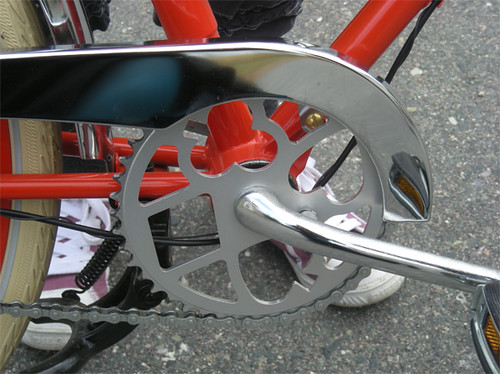
The "full suit" chainring and steel chainguard.
A prototype full chaincase is in the works - to be coated to match the frame colour. I am excited about this development. I have also been discussing dress guards with Mr. Flanigan, and I think you might be seeing something on that end as well pretty soon.
Other than adding a chaincase and dress guards, the only thing I would change about this bicycle if I had a magic designer's wand, would be the style of the fork. I like the straight forkblades here and think that their clean, utilitarian aesthetic is fitting with the overall design. But I wish that the "unicrown" fork (rounded top) could have a flat or "segmented" top instead. This is really a personal preference.
As you can tell by my ridiculous facial expression and firm grip, I liked this bicycle quite a lot and was excited to try it. The owner and I are similar in height, so the frame was just right for me.
The ride felt smooth, stable and effortless, and I love the 8-speed coaster brake hub. The ANT handled similarly to my Pashley once it got going, but was somewhat faster to accelerate and more maneuverable. At least in part this is probably due to the 10lb difference in weight (the ANT being the lighter of the two). Of course this was a very short ride, so I really cannot make far-reching conclusions based on this experience alone. What does it feel like loaded? on hills? in the rain? on a 30-mile ride? That I can't say. But riding it for that short time period made me want to find out. The ANT Boston Roadster is a classic, but with a twist that I would describe as "utilitarian chic".
...
TEST RIDE No.2: The Mixte
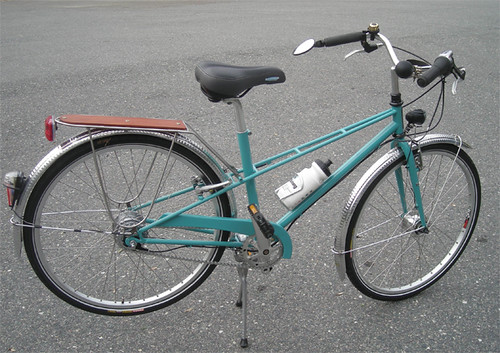
I am not certain whether ANT plans to offer the Mixte as a standard model, but they certainly can build it as a custom order. This turquoise mixte belongs to Betsy, Mike Flanigan's parter, and it is fairly unusual. As you can see, it is built with the classic twin lateral stays - but it lacks the rear stays that typically connect the seat tube to the rear drop-outs.
The frame was a size too small for me, but with the saddle raised it was fine. The bicycle does not feel like a mixte to ride - at least if you are accustomed to vintage mixtes, which were designed with road bike and sometimes touring frame geometry. It is much more stable, sturdy, and easier to operate than the typical mixte I am used to, with a relaxed sitting position, wide tires and an 8-speed hub. The bike was geared low and as a result was able to fly up the hill in a fashion I had not experienced before with hub gears. It was not a road bike, that's for certain. But I wouldn't describe it as a city bike or a "cruiser" either. Town and country? Yes, that seems about right. And with the wide tires, it is probably suitable for a variety of on and off road terrain.
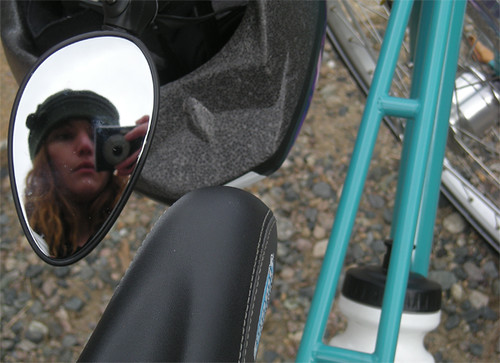
A close-up of the twin lateral stays and a gratuitous shot of my face in the rear view mirror. As on the Boston Roadster, you can see the nice clean welds.
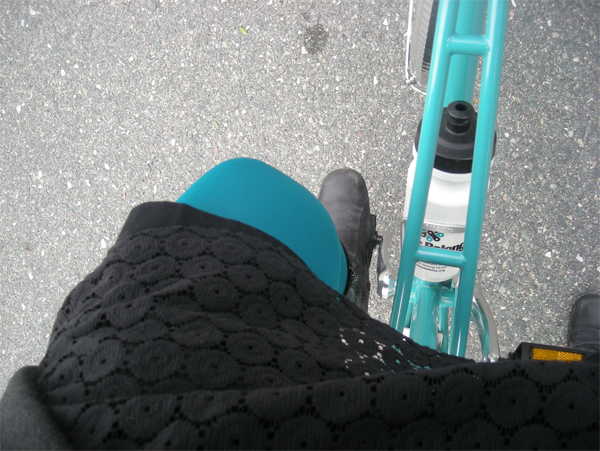
View from the saddle.
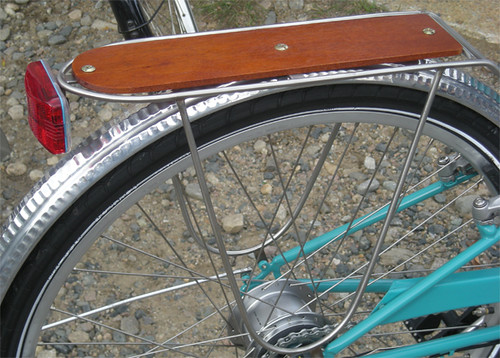
Custom rear rack with a wooden base; hammered Honjo fenders. Shimano 8-speed hub.
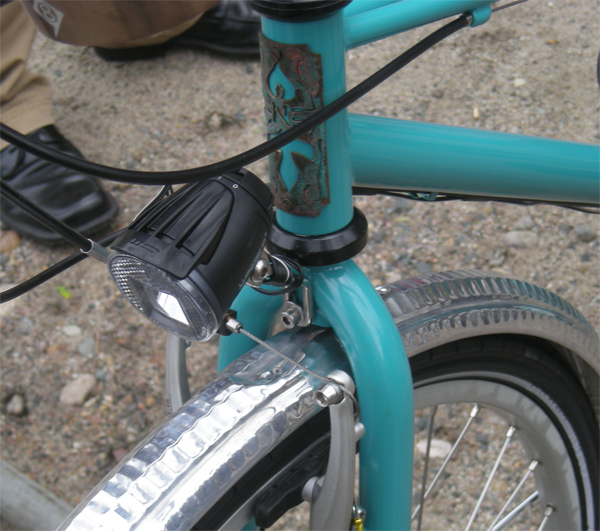
Dynamo-powered headlight.
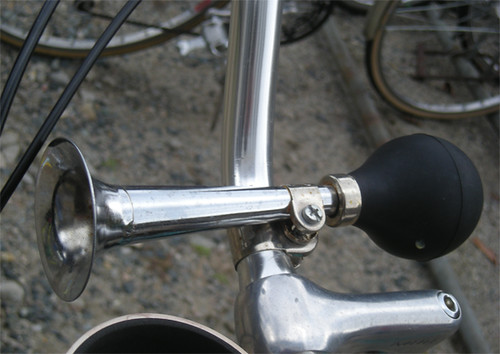
Retro bicycle horn on the handlebars. It cannot be denied that ANT has an eye for beautiful eccentricity - a definite plus in my view.
As a self-professed lug fanatic, it is funny that I like ANT's TIG-welded bikes so much. The clean welds are an integral part of ANT's "utilitarian chic" aesthetic, and as such they seem perfect just the way they are. It simply looks right. Does this change my obsession with lugs? Well, no. But let's just say that ANT is the exception to the rule.
I hope these descriptions were helpful to those curious about ladies' frame bicycles from ANT. I know that Mike Flanigan is working on some updates to the Boston Roadster models, and I am looking forward to the results.
TEST RIDE No.1: The Boston Lady Roadster
Other than adding a chaincase and dress guards, the only thing I would change about this bicycle if I had a magic designer's wand, would be the style of the fork. I like the straight forkblades here and think that their clean, utilitarian aesthetic is fitting with the overall design. But I wish that the "unicrown" fork (rounded top) could have a flat or "segmented" top instead. This is really a personal preference.
The ride felt smooth, stable and effortless, and I love the 8-speed coaster brake hub. The ANT handled similarly to my Pashley once it got going, but was somewhat faster to accelerate and more maneuverable. At least in part this is probably due to the 10lb difference in weight (the ANT being the lighter of the two). Of course this was a very short ride, so I really cannot make far-reching conclusions based on this experience alone. What does it feel like loaded? on hills? in the rain? on a 30-mile ride? That I can't say. But riding it for that short time period made me want to find out. The ANT Boston Roadster is a classic, but with a twist that I would describe as "utilitarian chic".
...
TEST RIDE No.2: The Mixte
As a self-professed lug fanatic, it is funny that I like ANT's TIG-welded bikes so much. The clean welds are an integral part of ANT's "utilitarian chic" aesthetic, and as such they seem perfect just the way they are. It simply looks right. Does this change my obsession with lugs? Well, no. But let's just say that ANT is the exception to the rule.
I hope these descriptions were helpful to those curious about ladies' frame bicycles from ANT. I know that Mike Flanigan is working on some updates to the Boston Roadster models, and I am looking forward to the results.
Posted in ANT, coaster brake, fenders, framebuilding, lights, loop frame, mixte, test rides
|
No comments
Subscribe to:
Comments (Atom)